


Let’s be honest — when you think philosophy, you probably imagine some old guy in a toga sitting under a tree, mumbling about virtue and destiny. And when you think Lucifer, you imagine the Devil in a tailored suit, sipping whiskey at Lux, flirting his way through crime scenes and parties. Two totally different worlds, right? Not really.
Because if you strip away the celestial drama and the fantasy elements, Lucifer Morningstar might be one of the most Stoic characters ever written — a fallen angel who slowly learns that control doesn’t mean power, that peace doesn’t come from pleasure and desire, and that redemption isn’t about forgiveness from others… it’s about acceptance of yourself.
---
Lucifer’s whole life is proof through adversity. He’s literally the fallen one, yet the show constantly challenges the idea that your past defines your worth.
That’s Stoicism in motion: who you are is not what happens to you — it’s how you respond.
Lucifer learns this slowly. Instead of punishing the wicked out of anger, he starts understanding them. He realizes revenge feels empty, but forgiveness - even for himself - feels freeing.
“You can’t control the Universe - but you can control yourself.”
This is the Stoic rule:
> “We suffer more often in imagination than in reality.” - Seneca
Lucifer’s biggest suffering isn’t physical - it’s emotional. Guilt, shame, fear of rejection. Sounds familiar? He constantly imagines himself as unworthy of love, and that thought is his Hell.
Epictetus, another Stoic, would’ve told him: “It’s not things themselves that disturb us, but our judgments about them.”
---
The Hell of the Mind
When Lucifer returns to Hell, we learn something fascinating: nobody’s torturing the souls. They’re torturing themselves. Each soul relives its regrets on loop, trapped by guilt.
That’s exactly how the Stoics described human suffering.
Epictetus, a former slave who became one of Stoicism’s great teachers, said:
> “It’s not what happens to you, but how you react to it that matters.”
Hell isn’t a place. It’s a state of mind.
It’s replaying every mistake you’ve ever made, every failure, every “what if,” until you’re chained to your own past.
Lucifer’s mission - especially in the later seasons - becomes to help those souls forgive themselves and move on. He becomes less of a punisher and more of a guide.
And that’s the Stoic way, too: stop fighting what’s already happened, and start asking what you can learn from it.
Lucifer proves his transformation by literally transforming Hell. Instead of a place of punishment, it becomes a place of healing. Souls aren’t trapped by flames - they’re trapped by guilt. When they forgive themselves, they’re free.
That’s Stoic psychology in a nutshell: it’s not the world that chains you, it’s your mind.
---
❤️Pleasure, Pain, and the Epicurean Twist
Now, Lucifer is famous for his love of pleasure - the parties, the drinks, the sex, the music. It’s indulgent, seductive, fun — and also totally exhausting.
He keeps trying to fill the hole inside him with more pleasure, but the more he gets, the emptier he feels.
That’s where Epicurus comes in - a philosopher often misunderstood as a “party guy,” but who actually taught that the highest pleasure comes from peace of mind, not endless luxury.
Epicurus said:
> “If you wish to be rich, do not add to your money, but subtract from your desires.”
Lucifer’s entire arc is that lesson in action. He learns that real happiness doesn’t come from indulgence but from intention. He starts choosing what truly matters - love, meaning, service - instead of chasing distractions.
The Devil, of all beings, learns to quiet the noise. That makes the whole narrative in the TV show so impressive.
---
The Mirror of Responsibility
One of Lucifer’s biggest catchphrases is: “Tell me, what is it you truly desire?”
It’s a cool party trick, sure. But it’s also a deep philosophical question.
Because to the Stoics, and even to Epicurus, self-awareness was everything. You can’t control your life if you don’t even know what drives you.
Lucifer uses his power to make others confront their desires - but by the end, he’s the one who learns from it. He realizes that for all his talk about freedom, he’s been a prisoner of his own need for validation.
That’s what philosophy — and life — is really about: holding up a mirror and asking yourself, “Am I living by choice, or by habit?”
---
Contemporary Stoicism
So what can we, ordinary humans, take from all this celestial drama?
Maybe Stoicism isn’t about being emotionless. Maybe it’s about not letting emotions run your life.
Maybe it’s not about “rejecting pleasure,” but about not chasing emptiness.
Maybe it’s about what Lucifer learns: you can’t rewrite your past, but you can redeem your present.
Here’s how you can be a little more “Lucifer-Stoic” in real life:
When you’re angry — pause before reacting. Ask: “What’s really in my control right now?”
When you’re sad or guilty — don’t push it away. Face it. Then forgive yourself.
When things go wrong — remember: you can’t choose the storm, but you can choose how to stand in the rain.

“I’m the Devil, but I’m not a bad guy.”
From the start, Lucifer is obsessed with identity. Everyone calls him “evil,” “fallen,” or “damned” — but he keeps asking, “Am I really those things?”
That’s the same kind of question ancient Stoics asked themselves. Seneca wrote:
> “No man is more unhappy than he who never faces adversity. For he is not permitted to prove himself.”

“I’m the Devil. I deal with punishment.”
At the start of the series, Lucifer is pure chaos.
He does what he wants, when he wants, and dares the universe to stop him. Every emotion hits him like a thunderstorm. Anger? He burns the world down. Love? He drowns in it. Guilt? It eats him alive.
He reacts — constantly.
That’s exactly what the Stoics warned against.
Seneca wrote:
> “He who is brave is free.”
And what he meant is this: freedom doesn’t come from having power over others — it comes from mastering yourself.
Lucifer has wings, money, immortality, charm — but no control over his own emotions. He’s the most powerful being in the room, and yet completely enslaved by impulse.
That’s how most of us live, too. Maybe we don’t have literal Hellfire, but we know what it feels like to be consumed by anger, guilt, or insecurity.
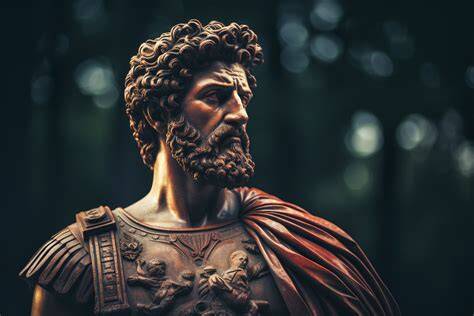
⚖️Fate vs. Free Will: The Celestial Tug-of-War
Throughout the show, there’s this huge debate: are we in control of our lives, or are we just pawns in some divine script?
Lucifer spends seasons rebelling against the idea that “God has a plan.” He refuses to be anyone’s puppet. But eventually, he realizes that acceptance doesn’t mean surrender. It means power.
The Stoics had a term for this: Amor Fati - “love of fate.”
Marcus Aurelius wrote:
> “A blazing fire makes flame and brightness out of everything that is thrown into it.”
Lucifer becomes that fire.
Instead of running from his fate, he embraces it - even when it hurts. He chooses to return to Hell, not because he’s condemned, but because he wants to help others break free.
He turns suffering into purpose. That’s Stoicism at its core.

Lucifer’s greatest power isn’t immortality — it’s self-mastery. That’s what Marcus Aurelius meant when he said:
> “You have power over your mind — not outside events. Realize this, and you will find strength.”

✨ The Devil’s Redemption (and Ours)
By the end of Lucifer, the Devil doesn’t get a throne in Heaven or a crown in Hell.
He gets something better — peace.
Because he finally stops running from himself. He accepts who he is — flaws, guilt, trauma, all of it — and turns it into something good.
That’s Stoicism.
That’s Epicurean wisdom.
That’s growth.
And maybe that’s what we’re all trying to do, in our own mortal way: learn to make peace with who we are, so we can finally start living as who we choose to be.
So the next time you’re facing chaos, or heartbreak, or guilt that won’t let go — channel your inner Morningstar. Pour a drink, look your demons in the eye, and say:
> “I can’t control everything. But I can control myself. And that’s enough.”
---
Final Thought
You don’t need angel wings or a devil’s charm to live like Lucifer.
You just need the courage to face yourself — to stop fighting what’s already happened, and start shaping what happens next.
Because the real power isn’t in ruling Hell or Heaven.
It’s in mastering your own mind.
> Be your own Morningstar — light in the dark, calm in the chaos, free in the fire.
Add comment
Comments